A picture is worth a thousand words.
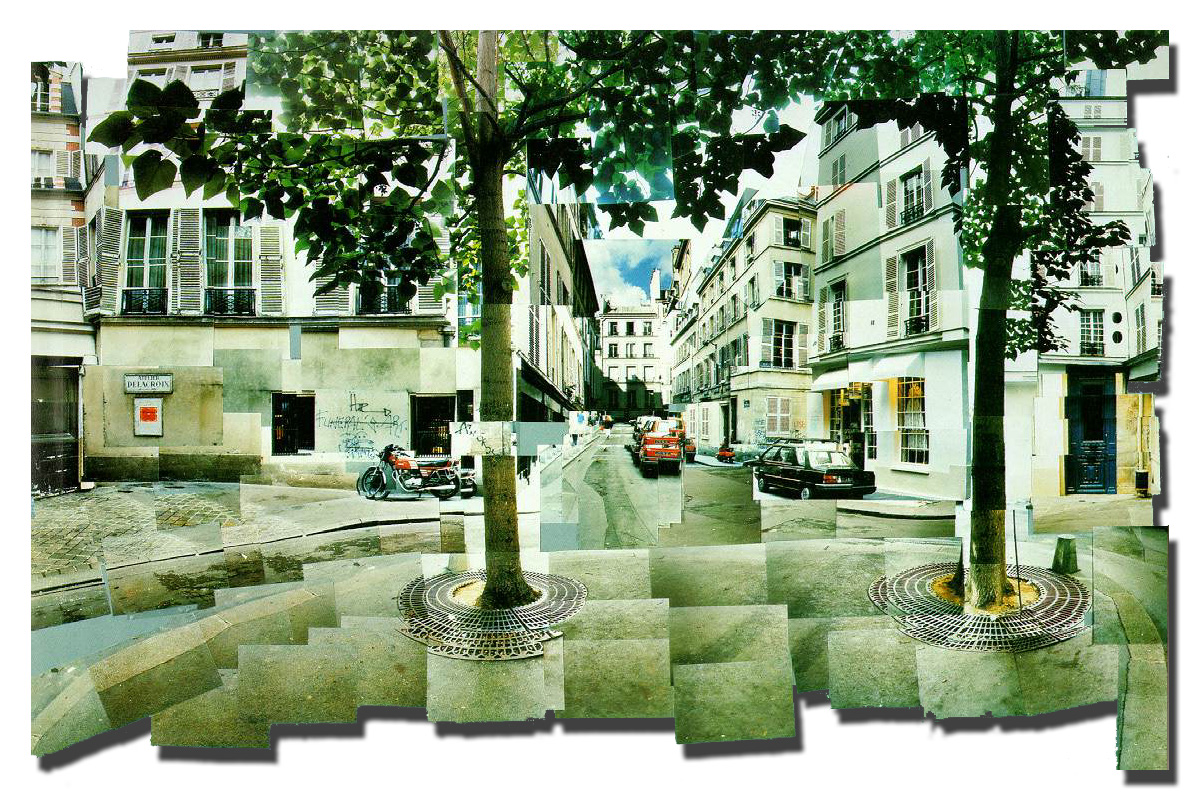
The photo collage that David Hockney created is vibrant in color there are all types of hues. Every object also is vibrant or diverse in colors. From the trees to the buildings to the sidewalk, everything is diverse. Hockney originally had a picture than he decided to cut it up and make it into a new creation. Which I found fasinating. I concluded that Hockney might of cut up other pictures to make this one collage. The reason for my theory is because some of the pieces in this collage does not coordinate well with the others. The photo collage is of square that I believe takes place in France or another European country. To my knowledge, I don’t believe the picture takes place in Africa or Asia. The object that first catches your eye is clearly the huge tree witch takes up a good portion of the piece. The tree is mostly green with some tints of brown. The trunk of the tree is brown while the topper part is dark brown/green. The top of the tree however, is the lightest of the whole. The leaves of the tree carry a similar completion that the trunk has. The leaves of the tree come in all different shapes and sizes. The darker shape leaves are much larger than those with a lighter tint. The thing that least catches your eye believes is the little square almost in the middle of the picture which is an image of the sky. Also, I noticed that there is another tree in the picture. The other tree is much darker than the bigger one. Everything is darker. The stem and the leaves. The trunk of the tree though, is the lightest. The completion is a yellowish/ brownish hint. Surrounded by a bunch of little rocks it seemed. Another thing that I noticed was that there are only two cars in the whole piece of art. I found this interesting because the cars are tiny, compared to the whole piece. The piece is large but the cars are small. The cars hue is red and black. Which sticks out when put near the white apartments. As a whole, the picture is very vibrant. The colors are light and sunny. When looking at the picture, the viewer feels a warm and welcoming scene. The picture, I noticed is only straight at the top of the picture. Every other side is not even or missing a piece. The bottom part of the picture is the roughest part of the picture compared to every other side. The picture as a whole does not look real. Only a couple of little squares can be telling as real to the viewer. Like some parts of the tree, the leaves could be seen as real. Also, another thing I noticed is that the very center of the picture is of a dark, small building. This struck me because I thought the center of the picture will be much bigger and more eye catching than what it is now. There is an ample amount of windows. Everywhere the viewer looks, there are windows. The windows mostly occupied the top half of the picture. None are seen in the bottom half. One thing I noticed about the windows is that they all are dark. The windows are covered by shades which I find interesting because the picture as a whole is very bright and lively. That is not the same case with the windows, however. The viewer who looks at the window senses darkness and not much hope. The picture is very diverse with every element. From shapes to hints there is diversity. The top of the picture is busy, filled with everything from apartments to windows to leaves. The bottom part of the picture is not as fortunate as the top half, though. The bottom part of the picture is indeed extremely plain. There is nothing important but the trunks of the trees. I also happened to notice that there are a lot of parallel things and doubles. There are two trees, which appear also exactly alike. There are also two cars and two doors. What is parallel I noticed are the trees and the buildings. I believe this collage was done quite a while ago. Perhaps in the 70’s or the 80’s. The reason I have this theory is because the cars appear to be those centuries and everything seems brighter. Also, the buildings seem like they were made around that time as well. I touched upon the subject earlier that I believe this picture was done in France other some other European country. The reason I believe this is because the square is very clear, compared to America, where people just throw everything on the ground and litter. The streets, as the viewer sees does not have paper or anything other type or form of trash. The street is extremely spotless with noting on it. This square, I believe belongs to a rather rich area in Europe. The reason I believe this is because everything the viewer sees can be connected to richness. There is nothing poor or tapped in the picture. Also, the picture has very earthy colors like earth brown and earth green. There are no neon colors or very dark colors, except for the shades. The also happens to be a lot of natural colors. Like the sidewalk and the door on the very edge of the picture. One thing that struck me about this picture is why there is only one visible door. There maybe other doors but the other doors are not visible to the viewer. Why did Hockney create the picture like this? Doors, to me symbolize freedom and hope. Though this picture does symbolize hope and freedom, it also does not in a way. Which obviously y in very controversy. The windows which symbolizes freedom as well are as I will say again are very dark and not welcoming. Why did Hockney make this picture the way he did? I will believe that he wants to show his viewers that there are always to sides or everything. There is always a dark side and a light side. There is always a hope side and not so bright side. Like everything in life, there is always two sides of things, just like this picture. Which Hockney did a great job describing.

